How to Read an Astrology Chart
If you’ve ever pulled up your birth chart and thought, “What am I even looking at?” you are definitely not alone.
The parts of a chart, from zodiac signs, planetary symbols, numbered houses, degrees, and multiple coloured lines (aspects), can look complicated. But you do not have to understand everything at once.
In this beginner’s guide, I’ll walk you through how to read your astrology chart step by step, so you can begin understanding what your own birth chart is capable of showing you.
The process starts with a basic pieces: the planets, zodiac signs, houses, and aspects and understanding how they work together. Astrological learning deepens as it stretches; you learn about the archetypes. This is how I start reading a chart.
How I Read a Birth Chart
The first thing I do when I begin an astrology reading is to take a minute to greet the chart. I look at the chart, whether on a screen or printed out on paper and take a minute to contemplate the “sky in my hand”.
After introducing myself–including my name–I ask for guidance to interpret a birth chart to a reader to lead a happier life. Then I put my hands together. It’s a silent ritual that only takes about two minutes (which you may have observed if you have done readings with me).
I started doing this during very early readings. There can be tense anticipation before an astrology session — both on the part of the reader and the person who is being read for, and I’ve found that connecting with the chart, on its own can improve the process.
An astrology reading is an opportunity to gain awareness for your natal promise and your journey ahead. It is helpful to write down questions. Anything that you feel you need clarity on. This helps you get the most out of your session and stay on track.
It is this process over many years that I use to teach you how to read an astrological chart.
What Is a Birth Chart?
A birth chart is a map of the sky at the exact moment and place you were born. It shows where every planet stood against the twelve signs of the zodiac at the minute of your birth, and which area of your life each one landed in. You might be born on the same day as another person, but being in different places, you get different charts.
The zodiac with its 12 signs is the heart of astrology. Its counter-clockwise journey represents our soul’s evolution, from the individual (1st house) to the collective/greater society (12th house).
That is why birth time is important. It casts the ascendant, and shows your growth as a person.
It is also important to know because the sky turns about one degree every four minutes and thus, your rising sign changes roughly every two hours. The rising sign is what sets the house structure underneath everything else.
Without a time you can still read enough of a chart through its planets and signs. You will recognise yourself through their archetypes. In fact, I start exploring birth chart patterns without the time for this reason. You can read more about this in my Inner Ether newsletter.
How to Read a Birth Chart Wheel for Beginners
Let’s start a birth chart by seeing what it is: a birth chart wheel. This is how we can approach it hierarchically rather than trying to absorb everything at once.
The wheel is divided into 12 houses, each representing a different area of your life, such as identity, family and roots, relationships, health, and career…
The 12 zodiac signs colour the energy of each house.
With the Whole Signs House system, each house begins at 0 degrees of the sign. The sign on your Ascendant becomes your entire 1st house, beginning at 0° of that sign, and every sign after it takes the next house in order. This makes the chart structure clear. It also looks visually simpler.
Whole Sign vs. Placidus: What’s the Difference?
Tecniques abound in astrology, but fundamentally, how do you cast the birth chart wheel?
Two systems are often used: Whole Sign Houses and Placidus.
Whole Sign Houses, apart from being simple to use, is associated with traditional timing techniques like profections. It is easy to make calculating transits to your houses. Beginners will find the birth wheel easier to interpret with this system.
Placidus produces a birth chart wheel that can create houses of different sizes. It can appear very uneven (such as if you’re born at the extreme latitudes). It is to depict how long it takes specific degrees of the zodiac to rise and set in the sky. However, the distortions can be extreme and even missing houses, making it harder to interpret.
It is the standard used in Modern Astrology, especially in psychological and evolutionary astrology. I started with Placidus for many years reading books on these topics.
Neither is better. They’re just different ways of looking at your chart.
The 12 Houses in Astrology
Was it the signs that drew you into astrology?
Sun in Leo, Moon in Scorpio, Pluto in Aquarius, placements such as these have entered our popular culture for good reason; their archetypes are vivid, easy to research, and endlessly discussed. But signs only tell part of the story. They describe how an energy tends to express itself.
Without the houses, a chart stays abstract. With them, it becomes a map of your lived experience, your relationships, your work, your home, your inner world, each with its own dedicated territory.
Your birth chart is like a snapshot of the sky at the moment you were born. It’s divided into 12 sections called houses, each representing a different area of life:
1st House : Identity & life approach (cusp = Ascendant)
2nd House : Money & Resources
3rd House : Communication & Learning
4th House : Home & Family
5th House : Creativity & Romance
6th House : Health & Daily Routine
7th House : Relationships & Partnerships
8th House : Transformation & Shared Resources
9th House : Higher Learning & Travel
10th House : Career & Public Life
11th House : Community & Aspirations
12th House : Spirituality & the Unconscious
A Simpler Way to Learn Astrology
Astrology can feel as vast as the skies itself. But you don’t have to get stuck or detached from what astrology is meant to do.
You don’t have to be blocked from getting to know your birth chart if you do not have a birth time either.
The reason is this: Where most people get stuck is trying to hold too many pieces at once. There are signs, houses, planets, meanings. Astrology operates in layers, and it can feel like too much information competing for your attention. We haven’t even gone into techniques yet.
I found out that the most productive conversations tended to occur after the reading is over. I’ve put the timings and profections away, and we are kicking back to discuss the meaning of the lights, the signs, etc.
People want to know what’s going on; but we are often craving to understand ourselves and our path here in this life.
That’s exactly why I created a more archetypal version of learning astrology.
You do not have to sieve and hold the pieces together in your head. You can explore the chart through its dominant patterns. This way, you explore signs and houses, moving through how each one functions. You get a feel for how the system works as a whole, especially in a birth chart for a person.
It’s a much easier way to start connecting the dots.
→ Explore your natal promise here
Astrology Symbols and What They Mean
The glyphs can make a chart look impenetrable but they are the symbols for the planets and many lights that mark the sky. Each one is an archetype before it is a symbol. Save and use my list below as a starting point.
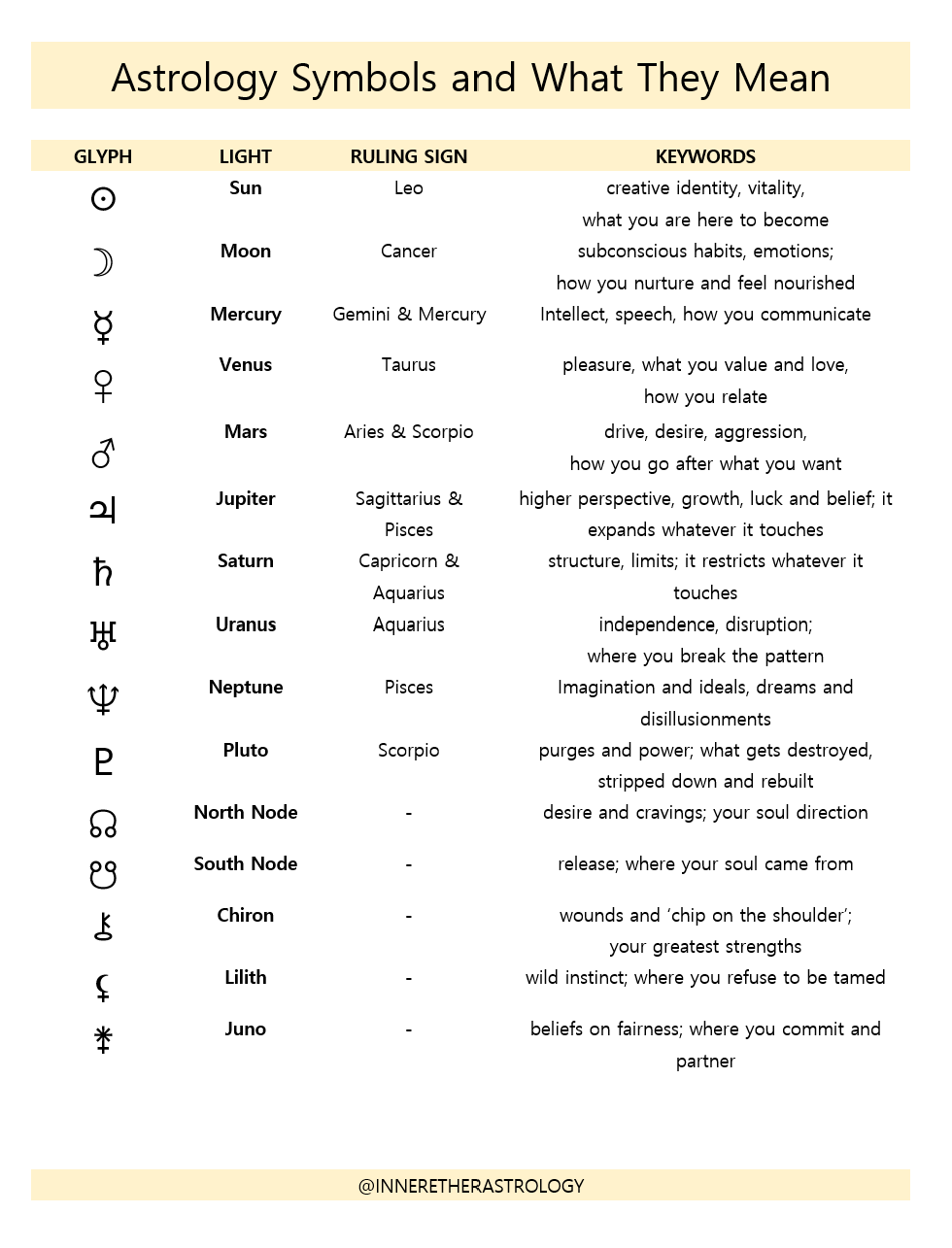
Astrology Symbols and What They Mean
Elements of a Birth Chart
Once you get to know the gylphs and their symbology, everything else in the chart makes easier sense.
You can start with part by part of the birth chart.
The planets are the function or energy (e.g., Mars = drive, assertion, conflict).
The zodiac signs colours the function or energy, showing the the style or manner.
The houses show the shows the life area, which is where the action takes place. This is time-sensitive.
Relatedly, these parts can be broken down or grouped further:
The "Big Three" are the three most fundamental points in modern Western astrology, each representing a different dimension of selfhood: the Sun, Moon, Ascendant.
The four angles are the most sensitive points in the natal chart, formed by the intersection of the ecliptic (zodiac) with the local horizon and meridian at the moment of birth. They define the skeleton of the house system. They are also the most personal, time- and location-specific factors in the chart.
Planetary Dignities (Strength by Sign) show the strength of the planets.
Major Aspects, or the angular relationships between planets in the chart.
Reading With An Astrologer
Remember that it is helpful to come with questions on pen and paper when you’re exploring your birth chart? If you do decide to have your chart read by an astrologer, use that. Every human being who sees things with their own lens. Your role is to get clear from your end, which helps in bringing you the astrologer that suits your needs.
Whether or not you read with an astrologer or read by yourself, you start to understand the planets and the chart. You start to interpret how they interact with each other. It’s a real study.